
A recent case from The clinic
The Patient

A recent patient came to me with chronic jaw pain that had been building for months. Two things were behind it: ongoing stress and orthodontic treatment. The patient was wearing clear aligners to correct a crossbite, and as their teeth gradually shifted, the muscles around the jaw became tight and overworked.
Their symptoms were typical of temporomandibular disorder (TMD):
Persistent jaw pain and tightness
Tension headaches, often around the temples
Teeth grinding and clenching, especially under stress
So, Why does this happen?
Qi Stagnation
In Chinese medicine, pain arises when qi and blood can’t move freely through the channels: “where there is obstruction, there is pain.” Jaw pain from stress and orthodontic treatment fits this pattern well, because there are two sources of stagnation layered on top of each other.
Stress and Liver qi stagnation
The Liver governs the smooth flow of qi throughout the body and nourishes the sinews (tendons and muscles). Ongoing stress, frustration, or emotional pressure causes the Liver’s qi to bind up. When that happens:
The sinews tighten. Liver qi stagnation shows up physically as muscle tension, and the jaw is one of the most common places for it to land. Clenching and grinding are the body “holding” what it can’t release.
The temples are affected. The Gallbladder channel, the Liver’s paired channel, travels across the temples and side of the head. Stagnant qi there produces the temporal tension headaches so common with TMD.
Wood overacts on Earth. In Five Element terms, an overactive Liver (Wood) can invade the Stomach and Spleen (Earth). The Stomach channel runs directly through the cheek and masseter region, so the jaw becomes a site where the Liver’s excess tension is expressed.
Local qi and blood stagnation from orthodontic treatment
Aligners add a local, mechanical source of obstruction:
Constant pressure and a shifting bite keep the tissues of the jaw under sustained strain, and unrelieved strain causes qi and blood to stagnate locally.
The Stomach (Yangming) channel passes over the jaw, cheek, and angle of the mandible. This channel is abundant in qi and blood, so when it becomes obstructed, the result is pronounced tightness and pain.
Clenching reinforces the problem. Stagnation tightens the muscles, tight muscles clench, and clenching further impedes the flow of qi. This is the same vicious cycle described biomedically, just seen through the channel system.
The Treatment
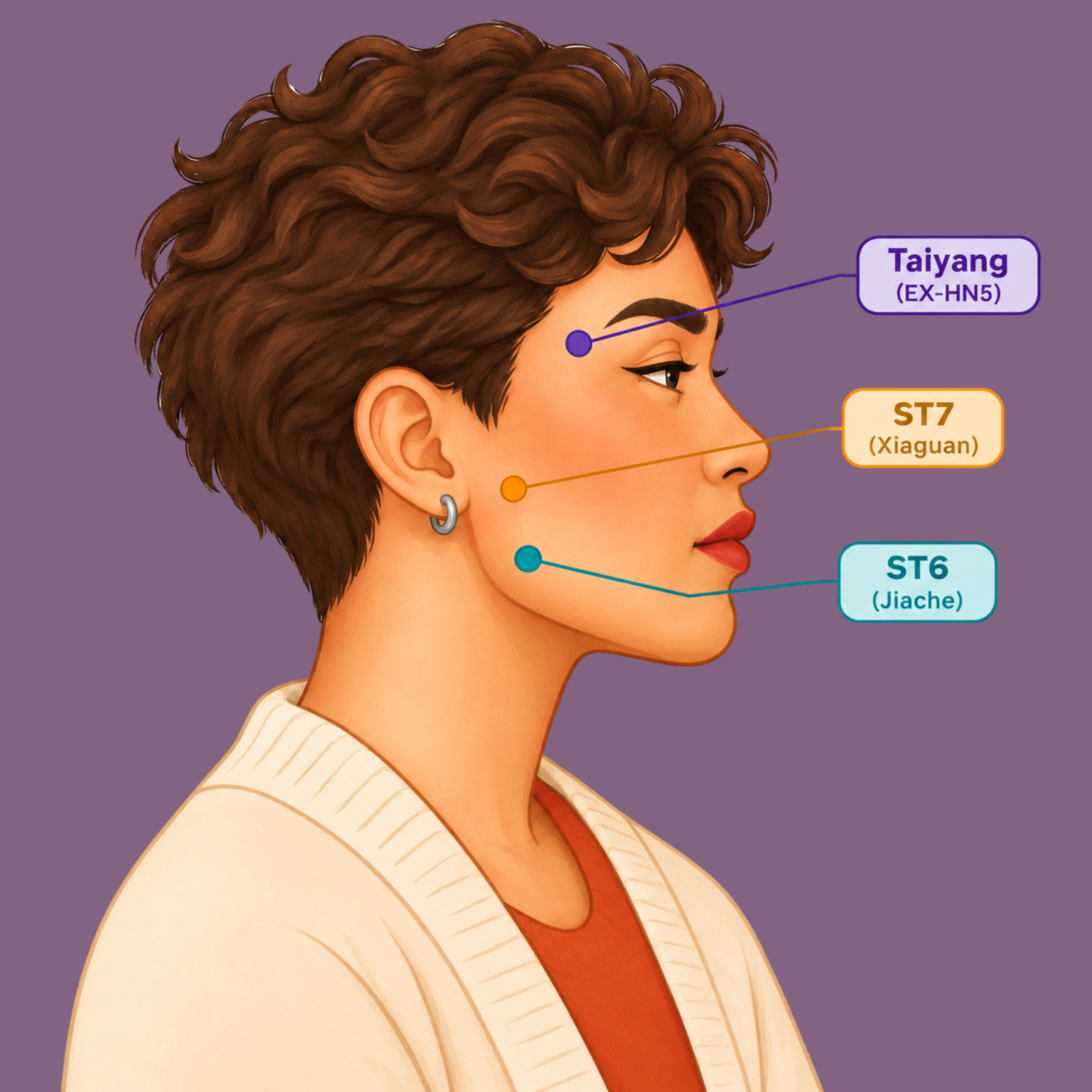
I focused on releasing the muscles at the center of the problem, using a combination of local points and electrical stimulation.
ST6 and ST7 with electrical stimulation: These are local points on the Stomach channel, directly over the area of obstruction. Additionally, these stomach channel points sit over the masseter muscle and near the temporomandibular joint. Needling them moves qi and blood, relaxes the sinews, and frees the channel. Electrical stimulation strengthens that effect, helping to “drive” the stagnant qi through, break up the held tension. Additionally, it encourages the muscle to release and relax more deeply than needling alone, and it can help interrupt the clenching pattern.
Taiyang: This extra point at the temple clears and activates the channels of the head and is classically used for headache. Because the temple is the Gallbladder channel’s territory, it also addresses the Liver-Gallbladder stagnation expressing as temporal tension. It was needled without stimulation to keep the treatment there gentle.
The Result
After one session, the patient’s jaw pain had resolved. The tension in the jaw eased, and the headaches and clenching that had been part of their daily life improved along with it. They were able to continue their aligner treatment with far more comfort.
As with any individual case, results vary. Every patient’s history, symptoms, and response to treatment are different, and some people need a series of sessions. This case is shared to illustrate how acupuncture can be used for TMD-related muscle tension, not as a guarantee of outcome.
Could This Help You?
You may be a good candidate for acupuncture if you:
Have jaw soreness or headaches during orthodontic treatment (aligners, braces, or retainers)
Wake up with a sore or tired jaw
Clench or grind your teeth, or have been told that you do
Get frequent tension headaches or migraines
Notice jaw clicking, tightness, or limited opening
Acupuncture can work alongside your dentist or orthodontist, and we’re happy to coordinate care. If you’re in the middle of treatment, keep wearing your aligners as directed and let your orthodontist know about any ongoing jaw pain.
Ready to find relief? Book an appointment to learn whether acupuncture is right for you.